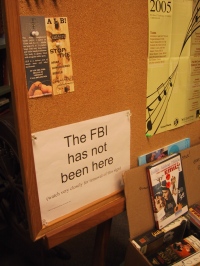
The Sad Story of Librarians’ Uncritical Attitude Toward Governmental Information

One proud example of librarians NOT being uncritical and indifferent toward Govt info
The fight against The Patriot Act: One proud example of librarians NOT being uncritical and indifferent toward Govt info

About this blog

I admit having been a crude moralist toward my librarian colleagues for years. It all started back in 2001 when I wrote a book, «-Videst mulig informasjon-» (in Norwegian only) on the sad story of many librarians’ indifferent and uncritical attitude toward governmental information, which is of course very often the propaganda of the majority of the city council or the parliament and government.

My article ‘Information Services and the Independent Public Library’ is a summary in English of this book, published in Information for Social Change (ISC) No. 18, Winter 2003 (pdf). Page 24 ff.

Excerpt:

«… by presenting official [governmental] information as a genre of its own similar to fiction and non-fiction and without offering any contrary information on the same subject, librarians are in my opinion failing in their duty. An absence of conflicting views is harmful to social processes and leads to a more superficial democracy.  … I also maintain that public libraries and their staff together with their national professional bodies reveal an attitude towards the authorities and their information activities which is uncritical and sometimes purely subservient. When loyalty is challenged there is a tendency towards self-censorship. Furthermore, any signs of tackling these problems have been ignored by central library forums».

Read the full text of the book at the National Library, however available for Norwegian IPs only.

Anders E.

The Monroeville HOT TOPICS – Far From Just Another Link Collection

Mark hudson
Mark Hudson with analogue resources in the reference area of Monroeville Public Library

Right at front when you open the website of Monroeville Public Library, Pennsylvania (no, not that Monroeville, fellow literature lovers), you are introduced to the library’s ‘Hot Topics’; i.e. sets of Web resources on local, national and international current issues. It was after my blog post two weeks ago, ‘How a Public Library Can Improve Public Participation and Democracy’, I was informed about ‘Hot Topics’ by Mark Hudson, Adult Services Librarian in Monroeville. He is one of the librarians responsible for Hot Topics.

About this blog

Read more: Les mer «The Monroeville HOT TOPICS – Far From Just Another Link Collection»

The Independent DEBATE LIBRARY is Born!

About this blog

This birth took place 1st January 2014 and at the same time in both Norway and Sweden. We are talking about the two countries’ library laws that were revised with new, radical formulations that promote democracy through debate and exchange of opinions in the public library.

The Norwegian law, combined with signals by the Minister of Culture, even gives the chief librarian status as an independent editor of library debates, in line with newspaper editors.

The law proposal was not uncontroversial. The debate raged about the chief librarian’s new status, in both the professional and the general press. Would the chief librarian still be overrun by the city council? Have librarians the right skills and attitude? However, a great number of libraries have now taken the plunge and organise debates. They experiment and gain experience. They do it so well, that the chairman of Norwegian PEN, William Nygaard (best known as the Norwegian publisher of Rushdie’s “Satanic Verses” and for having survived an assassination attempt against him in 1993), said that the library has comea long way in a short time with its own debate profile. And mayors and administrators have publicly approved the new free position of the chief librarian.

Surprisingly very little has been said or written internationally about this innovative new service and policy. However in the latest issue of ISC – Information for Social Change – I have an article titled «The New Independent Norwegian «Debate Libraries» (page 4 ff ), hoping that other library communities and associations will consider it.